 How-to
Macro Split for Fat Loss and Muscle Retention Explained
Quick Summary
A macro split for fat loss and muscle retention divides your daily calories among protein, carbohydrates, and fat after you set a calorie target. Many people start with roughly 30 to 35 percent protein, 35 to 40 percent carbohydrates, and 25 to 30 percent fat, then adjust based on results.
- Set your calorie target first; the macro split only divides that total.
- Protein protects muscle during a deficit, so avoid cutting it to save calories.
- A common protein range is about 1.6 to 2.2 grams per kilogram of body weight.
- Keep fat at a floor of about 0.3 grams per pound of body weight.
- Review your weight trend, waist, and strength every two to three weeks, changing one variable at a time.
Table of Contents
- What Macronutrients Do During a Calorie Deficit
- Why Protein Matters Most When You Are Cutting
- Macro Ratio for Fat Loss and Muscle Gain: Male Starting Points
- Macro Ratio for Fat Loss and Muscle Gain: Female Starting Points
- Macro Split for Fat Loss and Muscle Retention Calculator: Step-by-Step
- Training and Recovery While You Are in a Deficit
- How to Adjust Macros for Fat Loss Over Time
- Book Your Consultation to Build a Plan Around Your Body
- Frequently Asked Questions
What Macronutrients Do During a Calorie Deficit
Macronutrients are protein, carbohydrates, and fat. Each supplies energy in the form of calories, and each does a different job while you eat less than you burn. Understanding that split is the foundation for any macro split for fat loss and muscle retention.
During a calorie deficit, your body draws on stored energy. Fat stores supply much of that energy, but the body still needs protein to repair tissue and keep muscle in place. Carbohydrates fuel training and daily movement. Dietary fat supports hormone production and absorption of vitamins A, D, E, and K.
- Protein: Helps protect lean mass and supports recovery
- Carbohydrates: Fuel workouts and daily activity
- Fat: Supports hormones and essential body functions
Calories still matter most. A macro split can shape how you lose weight, but it cannot create a deficit on its own. Set your calorie target first, then divide that total across the three macronutrients.
Why Protein Matters Most When You Are Cutting
Protein is the macronutrient that most directly protects muscle when intake drops. Eating enough of it signals the body to keep lean tissue while fat comes off.
Protein is commonly associated with fullness. Many people find that higher protein meals keep hunger easier to manage during a diet.
Watch out: cutting protein to save calories often backfires. You may lose more muscle along with fat, which lowers your metabolic rate over time.
For many adults who train regularly, a common starting point is around 0.7 to 1 gram of protein per pound of goal body weight per day. Adjust based on how you feel, your training, and your results. If you have kidney disease or another medical condition, talk with your doctor before raising protein intake.
Looking for appetite support alongside your protein target? See our guide to 7 Natural Appetite Suppressants That Actually Work.
Macro Ratio for Fat Loss and Muscle Gain: Male Starting Points
Men who want to lose fat while keeping muscle often start with a moderate-to-high protein intake, a moderate carbohydrate intake, and a lower fat intake. Body size, activity level, and training volume all change the exact numbers.
A practical starting split for many men looks like this:
- Protein: 30 to 35 percent of daily calories
- Carbohydrates: 35 to 40 percent of daily calories
- Fat: 25 to 30 percent of daily calories
Men who lift heavy and train often may need more carbohydrates to fuel sessions. Men with a desk job and lower activity may do well with slightly fewer carbs and a bit more fat.
Treat these numbers as a starting point, not a rule. Track your weight trend and strength for two to three weeks before making changes.
Macro Ratio for Fat Loss and Muscle Gain: Female Starting Points
Women often respond well to a similar structure, though calorie targets are usually lower. A common starting split for many women looks like this:
- Protein: 30 to 35 percent of daily calories
- Carbohydrates: 35 to 40 percent of daily calories
- Fat: 25 to 30 percent of daily calories
Hormonal changes across the menstrual cycle, perimenopause, and menopause can affect appetite, energy, and recovery. Some women find they need more carbohydrates around heavy training weeks and more fat during certain phases of the cycle. Keep notes on how you feel and adjust gradually.
Women who are pregnant, breastfeeding, or managing a medical condition should work with a qualified clinician before following any macro plan.
Macro Split for Fat Loss and Muscle Retention Calculator: Step-by-Step
Most macro calculators online ask for your age, height, weight, and activity level, then spit out a percentage split.
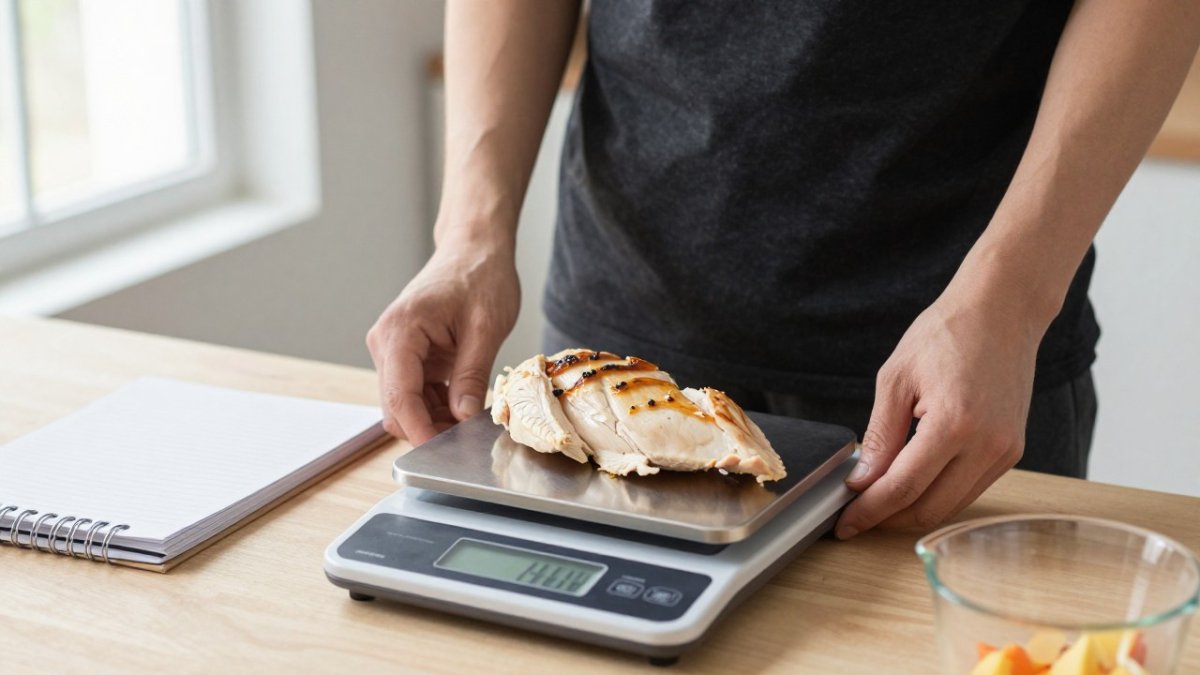
Here is the full calculation, using body-weight-based protein targets rather than percentages.
Step 1: Estimate maintenance calories. A common starting point is body weight in pounds multiplied by 14 to 16, depending on activity. A 180-pound person who trains four times per week and has an active job might use 15, giving roughly 2,700 calories per day.
Step 2: Set a moderate deficit. Subtract 300 to 500 calories per day from maintenance. A 500-calorie deficit is often described as producing about one pound of fat loss per week, though real-world results vary with adherence, activity, and water weight.
Step 3: Set protein in grams per kilogram of body weight. This is where body-weight-based targets beat percentages.
Step 4: Set a minimum fat intake. Fat supports hormone production and helps with absorption of vitamins A, D, E, and K. A common floor is about 0.3 grams of fat per pound of body weight, or roughly 20 to 30 percent of calories.
Step 5: Fill the rest with carbohydrates. Subtract protein and fat calories from your total calorie target, then divide by 4.
Worked example, start to finish: A 180-pound person training four days per week estimates maintenance at 2,700 calories, sets a 500-calorie deficit for a 2,200-calorie target, chooses 150 grams of protein (600 calories), sets fat at 60 grams (540 calories), and fills the remaining 1,060 calories with about 265 grams of carbohydrates. That works out to roughly 27 percent of calories from protein, 25 percent from fat, and 48 percent from carbohydrates, but the grams, not the percentages, drove the plan.
Watch out: rounding protein down to save calories is the most common error in this calculation. It is also the one most likely to cost you muscle.
If you prefer a percentage-based starting point, our guide to How to Calculate Macros for Weight Loss and Maintenance walks through that method as well.
The calculator walkthrough breaks down into five steps, each with a clear target, so here is the sequence at a glance.
| Step | What to do | Example figure |
|---|---|---|
| 1. Estimate maintenance | Body weight in pounds × 14 to 16 | 180 lb × 15 ≈ 2,700 kcal |
| 2. Set a moderate deficit | Subtract 300 to 500 kcal | 500 kcal deficit → 2,200 kcal |
| 3. Set protein | About 1.6 to 2.2 g per kg of body weight | 150 g protein (≈600 kcal) |
| 4. Set minimum fat | About 0.3 g per pound, or 20 to 30% of calories | 60 g fat (≈540 kcal) |
| 5. Fill with carbohydrates | Remaining calories ÷ 4 | ≈265 g carbohydrates |
Daily protein target: 2,200-calorie plan example
Training and Recovery While You Are in a Deficit
Resistance training is one of the main ways to signal your body to keep muscle during a calorie deficit. Lift weights two to four times per week, focusing on compound movements such as squats, presses, rows, and hinges.
Recovery matters just as much. Aim for seven to nine hours of sleep and avoid pushing training volume too high when you are already eating less.
- Train with progressive overload when possible
- Keep protein spread across three to five meals
- Watch for signs of excess fatigue, poor sleep, or declining performance
Strength training alongside medical weight loss can help protect muscle while you lose fat. Learn more in our guide to Strength Training with Medical Weight Loss. For exercise choices that support metabolism, see Best Resistance Training Exercises for Metabolism.
How to Adjust Macros for Fat Loss Over Time
A macro plan is a starting hypothesis, not a fixed prescription. The people who lose fat while keeping muscle are usually the ones who review results on a schedule, change one variable at a time, and resist reacting to daily scale noise.
Set a review cadence. Check in every two to three weeks rather than daily. Daily weight can swing by several pounds from sodium, carbohydrates, hydration, and menstrual cycle phase, so a single reading tells you almost nothing. A two-to-three-week block gives the trend time to show through.
Track four signals, not one.
- Weight trend: Average your daily weigh-ins across the review window and compare averages, not single days.
- Waist measurement: Measure at the same spot, same time of day, once per week. Waist circumference often moves when the scale stalls.
- Strength and training performance: Are your main lifts holding or progressing? A drop in strength across multiple sessions is a signal to eat more, not less.
- Adherence: If you hit your targets fewer than five days out of seven, the plan may be too restrictive to sustain. Fix adherence before changing the numbers.
Make one adjustment at a time. If weight is flat and strength is steady, reduce calories by about 100 to 150 per day, usually from carbohydrates or fat. If strength is falling, sleep is poor, or you feel depleted, add back 100 to 150 calories, preferably from carbohydrates.
Adjust for starting body composition and dieting history. The same split does not fit everyone. A leaner dieter with less fat to lose generally needs a smaller deficit and a higher protein intake to protect a smaller margin of muscle.
Know when to stop dieting. A calorie deficit is a stressor. Most practitioners find that planned breaks at maintenance, a week or two every couple of months, help with adherence, training quality, and hormone health.
When to seek professional guidance. Talk with a qualified clinician before starting or continuing a macro plan if you are pregnant or breastfeeding, have kidney or liver disease, diabetes, or another medical condition, or have a history of an eating disorder.
Adjusting macros is a feedback loop, not a one-time calculation. Review, change one thing, and let the trend, not the daily number, tell you whether it worked.
Book Your Consultation to Build a Plan Around Your Body
Every body responds differently to a macro split, and the right plan depends on your health history, medications, and goals. At Ideal Weight Loss & Cosmetic Center, board-certified physician Dr. Gina Nichols provides personalized, medically supervised weight management plans for patients in Columbus, Reynoldsburg, and Pickerington.
If you have struggled with hunger, stalled progress, or related metabolic conditions, you can book a consultation to discuss a plan that fits your health needs.
Last Updated: November 11, 2026
Frequently Asked Questions
What is the best macro split to lose fat and keep muscle?
There is no single best split, but a common starting point for fat loss with muscle retention is a higher protein intake, moderate carbohydrates and a fat intake that supports hormone health. Protein is the priority: many people aim for roughly 0.7 to 1.0 grams per pound of goal body weight per day, adjusted for training and body composition. Carbohydrates and fats then fill the remaining calories. Your macro split should be built from your own maintenance calories and reviewed every few weeks against your weight trend and strength.
How much protein should I eat to retain muscle while losing fat?
Research on people in a calorie deficit who are also resistance training generally supports protein intakes around 1.6 to 2.2 grams per kilogram of body weight per day, which is roughly 0.7 to 1.0 grams per pound. Higher intakes within that range can help when the deficit is large. Spread protein across meals and keep resistance training in your week. A clinician can help you adjust these targets if you have kidney or other medical concerns.
Do men and women need different macro ratios for fat loss?
The same calculation method applies to both, but starting calorie needs usually differ because men typically have more lean mass and higher energy requirements. Women often need fewer total calories, so protein and carbohydrate grams can be lower while still meeting protein targets per kilogram. Hormonal factors, life stage and training volume also change what works. Start from your measured maintenance intake rather than a fixed sex-based ratio.
How often should I adjust my macros during weight loss?
Review your macros every two to four weeks, using a weight trend averaged over at least a week rather than daily weigh-ins. If weight is not moving and adherence is good, reduce calories modestly, often by about 100 to 200 calories per day. If strength is dropping sharply, check protein, sleep and training volume before cutting further. Adjustments should be gradual so you can tell which change produced the result.