 how-to
7 Hormone Optimization Steps for Better Sleep
Last Updated: October 29, 2026
Quick Summary
Hormone optimization for improved sleep quality means addressing the hormonal drivers behind disrupted nights, since estrogen, progesterone, and cortisol act directly on the brain's sleep centers. A careful evaluation combines symptom tracking, targeted lab work, and screening for nonhormonal causes such as sleep apnea before any treatment decision. Careful timing and scheduled follow-up separate real hormone optimization from guesswork.
- Cortisol should fall in the evening and rise before dawn to support the circadian rhythm.
- Hormone therapy is best supported for easing hot flashes and night sweats, not sleep as a direct target.
- CBT-I is recommended as first-line care for chronic insomnia and works whether or not hormones are involved.
- Compounded bioidentical products are not FDA-approved, and purity, dosing, and absorption can vary.
- Track symptoms for two weeks and screen for apnea with tools such as STOP-BANG before pursuing hormone treatment.
Table of Contents
- How Hormones Control Your Sleep-Wake Cycle
- Hormone Imbalance and Insomnia: Signs to Watch For
- Menopause and Sleep Problems: Why Nights Get Harder
- Hormone Testing for Sleep Problems: What It Can and Cannot Show
- Treatment Options and the Strength of the Evidence
- Sleep Hygiene for Hormone Balance: Habits That Support Treatment
- Ruling Out Sleep Disorders and Nonhormonal Causes
- Booking a Hormone and Sleep Evaluation
- Frequently Asked Questions
How Hormones Control Your Sleep-Wake Cycle
Hormone optimization for improved sleep quality starts with one fact: sleep is a hormonal event, not just a habit. Stabilizing these fluctuations requires a consistent natural night routine to signal the body that the time for restorative rest has arrived.
Hormone balance is the daily coordination of these chemical signals. It is not a single number on a lab report.
Estrogen, Progesterone, and Cortisol at Night
Each hormone plays a distinct role after dark:
- Estrogen supports sleep onset and helps regulate body temperature overnight.
- Progesterone has a mild calming effect and supports breathing during sleep.
- Cortisol, the alertness hormone, should fall in the evening and rise before dawn.
The circadian rhythm depends on cortisol and melatonin moving in opposite directions. When cortisol stays high at bedtime, sleep latency stretches and sleep feels unrefreshing.
Hormone Imbalance and Insomnia: Signs to Watch For
Hormone imbalance and insomnia often travel together, but the pattern matters more than any single symptom. Watch for these signs:
- Trouble falling asleep despite feeling tired
- Waking at 2 or 3 a.m. and struggling to fall back asleep
- Night sweats or feeling overheated under normal bedding
One rough night means little. Readers who recognize these signs can find how to manage hormone imbalance symptoms. A repeating pattern over weeks deserves a medical look.
Menopause and Sleep Problems: Why Nights Get Harder
Menopause and sleep problems are closely linked because estrogen and progesterone decline unevenly, not in a straight line. For a deeper explanation, see why hormone levels fluctuate with age. During perimenopause, levels swing widely, which can make sleep patterns unpredictable month to month.
Two symptoms do most of the damage:
- Hot flashes raise skin temperature and trigger awakenings.
- Night sweats soak bedding and fragment the second half of the night.
These are called vasomotor symptoms, and they often cluster with lighter sleep and more arousal events. Many people also notice more sleep disturbances as hormonal changes progress.
Hormone Testing for Sleep Problems: What It Can and Cannot Show
Hormone testing for sleep problems can confirm where levels sit, but it cannot prove those levels cause poor sleep. That distinction matters.
What testing can show:
- Current estrogen, progesterone, and testosterone levels
- Thyroid function, which affects energy and sleep
- Cortisol patterns when measured appropriately
What testing cannot show:
- A guaranteed cause of your insomnia
- Whether a treatment will work for you
- A single "correct" number that applies to everyone
Results are read alongside symptoms, age, cycle status, and medical history. A lab value alone rarely tells the full story.
Treatment Options and the Strength of the Evidence
Treatment choices range from lifestyle support to prescription hormone therapy, and the evidence is strongest for specific problems, not for sleep in general. Readers comparing approaches can learn how hormone optimization differs from hormone replacement therapy. The most useful way to read the research is to separate what a treatment is proven to do from what it is merely hoped to do.
Book your consultation today →
What the Evidence Supports, Option by Option
- Hormone replacement therapy (systemic estrogen, with or without a progestogen): The best-supported use is easing vasomotor symptoms, hot flashes and night sweats. When those symptoms are the reason sleep breaks apart, treating them often improves self-reported sleep quality. The evidence for sleep as a direct target, independent of vasomotor symptoms, is weaker and mixed.
- Cognitive behavioral therapy for insomnia (CBT-I): Strong evidence for insomnia itself, including sleep onset and maintenance problems. It is recommended as first-line care for chronic insomnia by major clinical bodies, and it works whether or not hormones are involved. It does not treat hot flashes.
- Nonhormonal hot flash medications: Options such as certain antidepressants and other agents can reduce vasomotor symptoms when hormone therapy is not appropriate. Sleep benefit is usually indirect, through fewer awakenings from heat.
Self-Reported vs. Measured Sleep: Why the Evidence Looks Mixed
Most studies rely on self-reported sleep quality, questionnaires and diaries. Measured outcomes tell a more nuanced story:
- Sleep duration and efficiency may improve modestly with hormone therapy, often in people with vasomotor symptoms.
- Sleep latency (time to fall asleep) and arousals (brief awakenings) show inconsistent results across studies.
- Objective measures such as polysomnography often detect smaller changes than patients report, which is why symptom relief and measured sleep can diverge.
A common pattern is that people feel better because night sweats and awakenings decrease, even when total sleep time barely moves. That is a real benefit, just not the same claim as "hormones fix sleep."
Matching the Treatment to the Driver
| If the main driver is... | First-line consideration | What to watch |
|---|---|---|
| Hot flashes and night sweats | Hormone therapy or nonhormonal hot flash medication | Reassess at scheduled intervals; do not continue indefinitely without review |
| Insomnia with no vasomotor symptoms | CBT-I | Hormones are unlikely to be the answer on their own |
| Suspected sleep apnea or restless legs | Sleep study or screening first | Treating hormones before ruling these out wastes time |
| Mixed picture | Combination approach with clinician supervision | Track symptoms and measured outcomes separately |
Hormone Therapy, Timing, and Monitoring
Timing and follow-up separate careful care from guesswork. A typical pathway includes:
- A full history and baseline labs
- A discussion of risks, benefits, and personal health factors
- A starting dose with a scheduled review
- Rechecking symptoms and levels before any adjustment
- Ongoing monitoring for as long as treatment continues
Watch out: starting hormones without a plan for follow-up makes it impossible to tell what is working and what is causing side effects.
Sleep Hygiene for Hormone Balance: Habits That Support Treatment
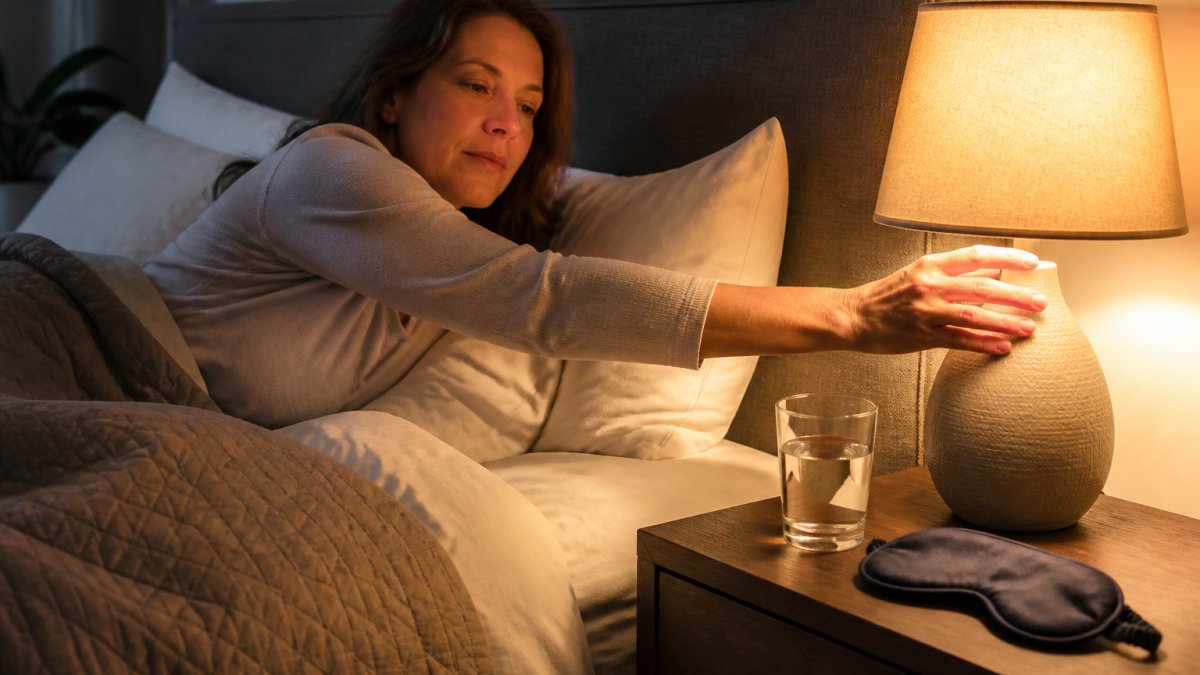
Sleep hygiene for hormone balance supports treatment but does not replace it. Habits shape the same pathways hormones control.
- Keep a consistent sleep and wake time, weekends included
- Dim lights in the hour before bed to support melatonin
- Keep the bedroom cool to reduce night sweats
- Limit alcohol, which fragments sleep later in the night
These steps help sleep regulation and can reduce symptoms while medical care addresses the underlying cause.
Ruling Out Sleep Disorders and Nonhormonal Causes
Not every sleep problem is hormonal, and treating hormones when the real issue is a sleep disorder wastes time and can delay effective care. Most supplied guides mention this in passing; the practical step is knowing which nonhormonal causes to screen for, what each looks like, and what to do next.
The Nonhormonal Causes Worth Screening First
- Obstructive sleep apnea: Loud snoring, gasping or choking during sleep, witnessed pauses in breathing, morning headaches, and heavy daytime sleepiness. Risk rises with excess weight, large neck circumference, and age. Untreated apnea fragments sleep regardless of hormone levels.
- Restless legs syndrome: An urge to move the legs, usually in the evening or at rest, relieved by movement. It delays sleep onset and is sometimes linked to low iron stores.
- Chronic insomnia disorder: Difficulty falling or staying asleep at least three nights a week for three months or longer, with daytime consequences. This is a diagnosis in its own right, not just a symptom.
- Anxiety, depression, and chronic stress: These raise evening cortisol and make wind-down difficult. Mood screening belongs in any sleep evaluation.
A Practical Screening Sequence
- Two weeks of symptom tracking: Bedtime, wake time, awakenings, night sweats, snoring reports from a partner, daytime sleepiness, and caffeine or alcohol timing.
- A validated screening questionnaire: Tools such as the STOP-BANG questionnaire flag apnea risk; the Epworth Sleepiness Scale gauges daytime sleepiness. These are quick and can be completed before a visit.
- Medication and supplement review: Bring a complete list to the appointment.
- Targeted lab work: Thyroid function and iron studies (including ferritin) where restless legs are suspected, alongside hormone panels.
- Referral when indicated: A sleep study for suspected apnea; CBT-I for chronic insomnia; mental health support for mood-driven sleep problems.
The American Academy of Sleep Medicine publishes guidance on when testing is appropriate.
When to Escalate
Persistent or severe symptoms, sleepiness that interferes with driving or work, chest pain, or mood changes that affect daily life, need prompt assessment rather than a wait-and-see approach. A structured evaluation connects symptoms, labs, and sleep history into one plan, and ruling out nonhormonal causes is the first step that makes any hormone decision meaningful.
Booking a Hormone and Sleep Evaluation
A structured evaluation connects symptoms, labs, and sleep history into one plan. Before booking, beginners can read how to start hormone optimization. The steps below show what to expect:
| Step | What Happens | Why It Matters |
|---|---|---|
| 1. History review | Symptoms, cycle status, medications, sleep habits | Sets the baseline |
| 2. Screening | Apnea and thyroid screening | Rules out nonhormonal causes |
| 3. Lab work | Estrogen, progesterone, cortisol, thyroid | Confirms where levels sit |
| 4. Plan | Treatment options with risks explained | Matches care to cause |
| 5. Follow-up | Scheduled rechecks and adjustments | Tracks real progress |
At Ideal Weight Loss & Cosmetic Center, board-certified physician Dr. Gina Nichols brings over two decades of experience to personalized, medically supervised care.
Frequently Asked Questions
Can hormone optimization improve sleep quality?
It can help when poor sleep traces back to hormonal causes. Estrogen and progesterone affect sleep onset and staying asleep, and cortisol timing shapes the sleep-wake cycle. Correcting a diagnosed imbalance may reduce night sweats, hot flashes, and nighttime waking. Results vary by person, and sleep problems often have several causes at once, so a clinician should assess thyroid function, sleep apnea risk, and medication use before attributing insomnia to hormones alone.
Can hormone imbalance cause insomnia?
Yes, in some cases. Falling estrogen during perimenopause is linked to night sweats and arousal events that break sleep, while low progesterone may affect sleep onset. High evening cortisol from stress can also keep you alert at bedtime. Because insomnia has many triggers, including caffeine, anxiety, and sleep disorders, testing helps confirm whether a hormonal imbalance is actually driving your symptoms before treatment begins.
How long does hormone therapy take to improve sleep?
Some people notice less nighttime waking and fewer hot flashes within a few weeks, while others need several months of adjustment and follow-up visits. Sleep latency and sleep efficiency tend to improve gradually rather than overnight. Your clinician will typically reassess symptoms and, where appropriate, hormone levels after starting treatment, and adjust the plan based on how you respond.
What are the risks of hormone therapy for sleep?
Hormone therapy carries real risks that depend on the type, dose, route, and your personal health history, including cardiovascular and breast cancer considerations for some patients. It is not appropriate for everyone. A board-certified physician should review your history, explain benefits and risks in plain terms, and monitor you during treatment. Sleep hygiene changes and treatment of nonhormonal causes such as sleep apnea may be recommended first or alongside therapy.
Poor sleep linked to hormonal changes rarely resolves on its own, and guessing at treatment can cost months. Ideal Weight Loss & Cosmetic Center offers personalized hormone optimization, customized metabolic plans, and physician-led follow-up, all under the care of a board-certified physician. Get started with Ideal Weight Loss & Cosmetic Center and build a plan that targets the real cause of your sleepless nights.