 comparison
Non-Surgical Fat Removal Alternatives for Men
Table of Contents
- Quick Comparison: Non-Surgical Fat Removal Options for Men
- Cryolipolysis: Freezing Stubborn Fat Pockets in Men
- FDA-Cleared Fat Reduction Technologies Explained
- How Long Do Non-Surgical Fat Removal Results Last?
- Non-Invasive Body Contouring Recovery Time for Men
- Male-Specific Considerations and Post-Procedure Maintenance
- Frequently Asked Questions
Last Updated: September 14, 2026
Quick Comparison: Non-Surgical Fat Removal Options for Men
Non-surgical fat removal alternatives for men are FDA-cleared treatments that reduce localized fat without incisions, anesthesia, or extended downtime. Most men pursue them for stubborn fat pockets that resist diet and exercise, not for overall weight loss.
This guide from Ideal Weight Loss & Cosmetic Center breaks down how each technology works, how long results last, and what recovery looks like.
| Treatment | Technology | Best For | Downtime |
|---|---|---|---|
| Cryolipolysis | Controlled cooling | Small, pinchable fat pockets | None |
| Emsculpt Neo | Radiofrequency + electromagnetic | Fat reduction plus muscle tone | None |
| SculpSure | Laser heat | Abdomen, flanks, back, thighs | None |
| Vanquish ME | Radiofrequency | Larger areas like full abdomen | None |
| Injectable deoxycholic acid | Fat-dissolving injection | Submental fat under the chin | Mild swelling |
The key distinction: these treatments reduce fat cell count in a treated area, while weight loss programs shrink fat cells throughout the body. A man carrying significant excess weight needs a metabolic plan first, with contouring as a finishing step, a sequencing question that shapes which option makes sense.
Cryolipolysis: Freezing Stubborn Fat Pockets in Men
Cryolipolysis applies controlled cooling to subcutaneous fat, triggering fat cell apoptosis while leaving surrounding tissue intact. The body clears the destroyed cells through normal metabolic clearance over the following weeks.
Men carry fat differently than women: adipose tissue concentrates around the abdomen and flanks in firmer, more fibrous compartments, which affects both candidacy and how many treatment cycles an area needs.
Cryolipolysis systems hold FDA clearance for fat reduction across multiple body areas (accessdata.fda.gov). Published data generally reports meaningful fat layer reduction, though outcomes vary with body mass index, skin laxity, and sessions completed.
The honest limitation: results are not immediate. Fat cell clearance takes weeks to months, and one session rarely produces the final result.
FDA-Cleared Fat Reduction Technologies Explained
FDA-cleared fat reduction technologies fall into four families: cooling, laser, radiofrequency, and injectable deoxycholic acid. Each destroys fat cells differently and carries its own safety profile, clearance scope, and candidacy requirements. For men, the practical differences come down to which body areas a device is cleared to treat, how fibrous the fat there is, and how many sessions a realistic result requires.
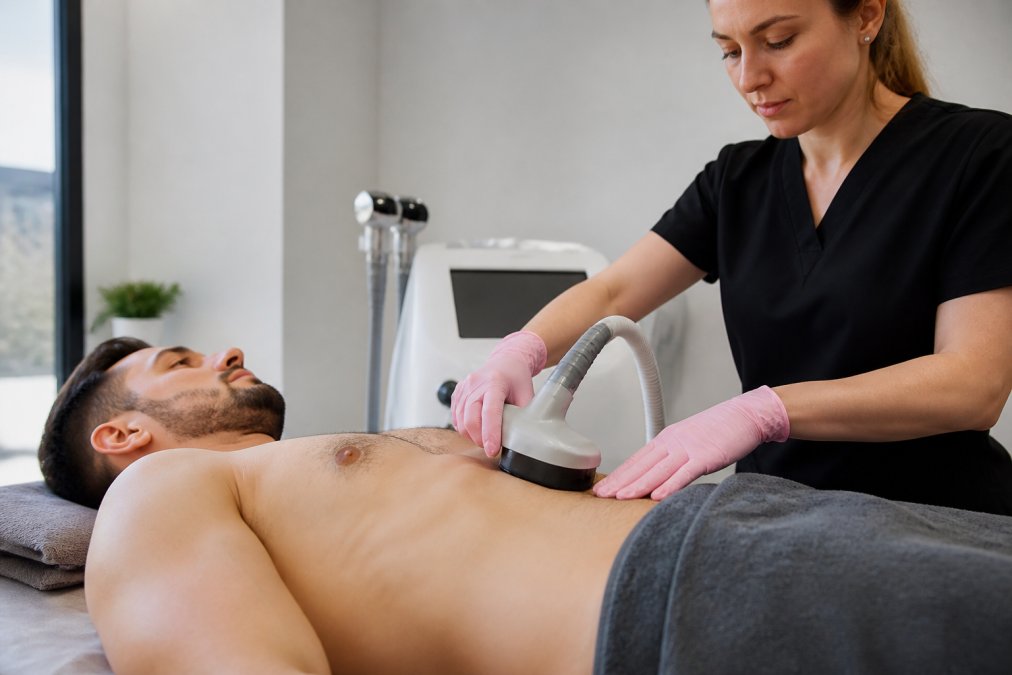
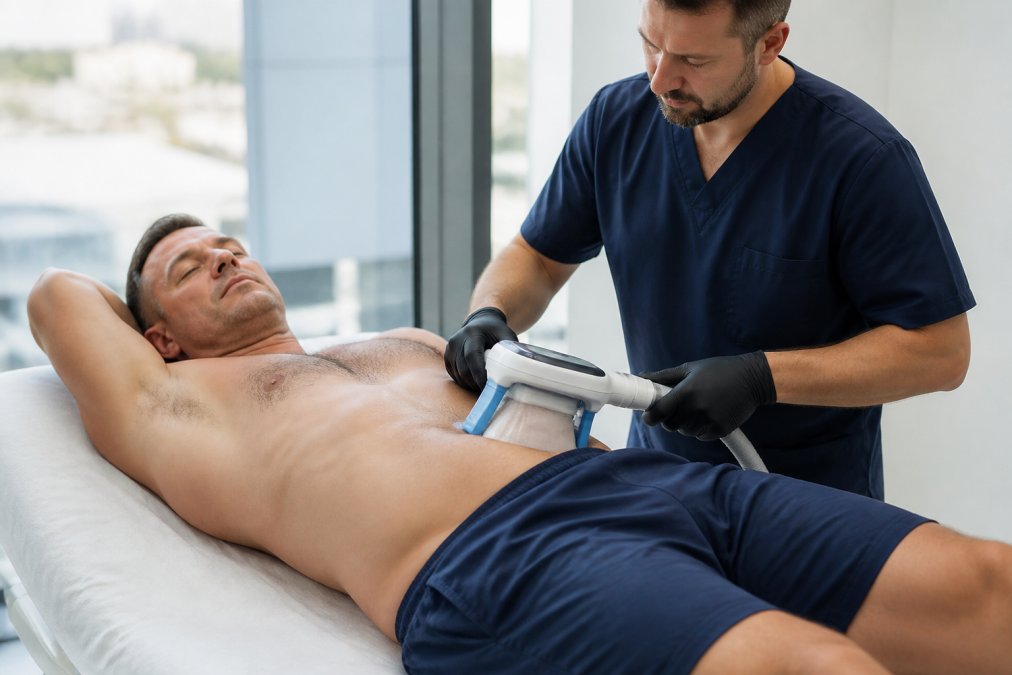
Cryolipolysis (controlled cooling). A vacuum applicator pulls a fold of tissue against a cooling plate, bringing subcutaneous fat to a temperature that triggers apoptosis while sparing the skin, nerves, and muscle above it. Cryolipolysis systems are FDA-cleared for fat reduction in several areas including the abdomen and flanks. Each cycle runs roughly 35 to 60 minutes, and most men need more than one cycle per area. The male-specific catch: abdominal and flank fat in men is often denser and more fibrous than in women, so a single applicator placement may move less fat. Some clinics use a larger or curved applicator, or pair cryolipolysis with a vibration or massage attachment, to improve uptake in firmer tissue.
Laser lipolysis (controlled heat). Laser lipolysis systems use diode laser energy through flat applicators on the skin, heating fat to disrupt fat cell membranes while contact cooling protects the surface. They hold FDA clearance for non-invasive lipolysis of the abdomen, flanks, back, and thighs. A session runs about 25 minutes per area, and since applicators cover a defined footprint, a wide abdomen may need two placements. Men with a high body mass index are not good candidates because the laser must penetrate a fat layer of manageable thickness.
Radiofrequency (bulk heating and muscle stimulation). Two approaches sit in this family. Some non-contact radiofrequency systems heat a large area without touching the skin, letting them treat the full abdominal circumference in one session, useful for broader contouring rather than a single pinchable pocket. Other systems combine radiofrequency heating for fat reduction with high-intensity focused electromagnetic energy for muscle contraction, addressing muscle definition alongside fat. Sessions run about 30 minutes, and a series is required for visible change. Neither suits significant obesity, and both depend on enough underlying muscle to respond to the electromagnetic component.
Injectable deoxycholic acid. A synthetic bile acid that dissolves fat cell membranes when injected into subcutaneous fat. It is FDA-cleared specifically for submental fat under the chin, not the abdomen or flanks (accessdata.fda.gov). A typical plan involves multiple sessions spaced about a month apart, each using a grid of small injections. Swelling after each session is expected and often more noticeable than with device-based options.
A note on "FDA-cleared" versus "FDA-approved." Device-based fat reduction technologies go through the FDA's 510(k) clearance pathway, meaning the manufacturer demonstrated substantial equivalence to a legally marketed predicate device; injectable deoxycholic acid went through a different pathway. Both mean the technology was reviewed for its stated indication, but neither means a given clinic, provider, or protocol has been individually vetted. That distinction matters when comparing quotes across clinics.
FDA 510(k) premarket notification database
How Long Do Non-Surgical Fat Removal Results Last?
Non-surgical fat removal results last years in most cases, because destroyed fat cells do not regenerate. The treated area retains a reduced fat cell count permanently, provided body weight stays stable. What most guides skip is that the male body has specific ways of undoing a good contouring result, understanding them is the difference between a result that holds and one that quietly fades.
The permanence claim comes with a condition. Remaining fat cells in the area can still enlarge if a man gains weight. A treated flank that loses 25 percent of its fat cells can still look fuller six months later if the surviving cells expand. This is why post-procedure maintenance matters as much as the procedure itself, and why the maintenance plan for a man looks different from the one usually printed in a clinic brochure.
Hormonal status is the factor most guides leave out. Testosterone, cortisol, and insulin all influence where a man stores fat. Low testosterone shifts fat storage toward the abdomen and flanks and makes contouring results harder to hold, because the underlying signal telling the body to deposit fat there has not changed. A man told his testosterone is "low-normal" may still store fat in a male-pattern distribution that responds poorly to contouring alone. A board-certified physician can evaluate this alongside the aesthetic plan. The same logic applies to insulin resistance: poor blood sugar regulation keeps the body storing abdominal fat regardless of how many fat cells were removed.
Book your consultation today →
A realistic maintenance plan for men looks like this:
- Hold body weight within a stable range rather than cycling up and down. Weight regain after contouring tends to return to the treated area first in many men, which is the opposite of what patients expect.
- Keep resistance training in the weekly routine to preserve muscle mass. Muscle is metabolically active tissue, and losing it during a weight-loss phase makes future fat regain more likely.
- Address underlying metabolic issues such as insulin resistance or low testosterone, which drive abdominal fat storage.
- Keep protein intake high enough to support muscle retention during any weight-loss phase.
- Return for a maintenance session only if a specific area regains fat, not on a fixed schedule. There is no clinical reason to retreat an area that has held its result.
For the injectable option, repeat treatments are sometimes needed to reach the desired result in the submental area, and the same hormonal and weight-stability factors apply.
The expectation problem. Men often arrive after years of frustration with a midsection that will not respond to training, and that frustration shapes what they expect. Two honest points help set the frame before treatment:
- Contouring changes the shape of a specific area. It does not change overall body weight or metabolic health. A man who wants to lose 30 pounds is looking at a metabolic plan, not a contouring plan.
- Results look natural, which means they can feel underwhelming to someone expecting a dramatic transformation. The change is real, but it is a change in silhouette, not a change in size.
The men happiest with their results treated contouring as the finishing step on top of a metabolic and training plan, not a substitute for one. Settle that sequencing question in the consultation, before any applicator is placed.
Non-Invasive Body Contouring Recovery Time for Men
Non-invasive body contouring recovery time is minimal. Most men return to work the same day, and the FDA-cleared technologies covered here involve no incisions, no general anesthesia, and no surgical recovery.
Expect the following in the first days after treatment:
- Cryolipolysis: temporary numbness, redness, or mild bruising at the applicator site, resolving within days to a couple of weeks
- Emsculpt Neo: muscle soreness similar to a hard workout, typically fading in a day or two
- SculpSure: warmth and tenderness in the treated area for a few days
- Vanquish ME: mild warmth or redness, since the device never contacts the skin
- Injectable deoxycholic acid: swelling, bruising, and tenderness under the chin, often the most noticeable of the group
A common mistake is scheduling a session immediately before an event or photo shoot. Swelling and tenderness are normal, and the visible result takes weeks to develop anyway. Build in a buffer.
Male-Specific Considerations and Post-Procedure Maintenance
Male fat distribution, skin thickness, and hormonal profile all affect how body contouring performs. Men store fat in firmer, more fibrous subcutaneous compartments, particularly at the abdomen and flanks, which can mean more treatment cycles per area than a woman of similar size needs.
The psychological side deserves equal attention. Men often arrive after years of frustration with a midsection that will not respond to training, and that frustration shapes expectations. Two honest points help:
- Contouring changes the shape of a specific area. It does not change overall body weight or metabolic health.
- Results look natural, which means they can feel underwhelming to someone expecting a dramatic transformation.
Post-procedure maintenance for men comes down to three habits. Keep protein intake high enough to preserve muscle. Keep training consistent, especially resistance work. And keep metabolic markers monitored, since blood pressure, blood sugar, and hormone levels all influence where fat accumulates.
A man dealing with both stubborn fat and persistent fatigue is usually looking at two connected issues, not two unrelated ones. At Ideal Weight Loss & Cosmetic Center, board-certified physician Dr. Gina Nichols evaluates metabolic health, hormone optimization, and body contouring as one plan rather than separate appointments, which is often what separates a result that holds from one that fades.
Stubborn fat that ignores diet and training is frustrating, and it rarely resolves on its own. Ideal Weight Loss & Cosmetic Center offers personalized, medically supervised plans that combine non-surgical body contouring, hormone optimization, and customized metabolic care under board-certified physician Dr. Gina Nichols, with more than two decades of experience and minimal downtime. Get started with Ideal Weight Loss & Cosmetic Center and build a plan that addresses both the fat and the reason it settled there.
Frequently Asked Questions
What are the most effective non-surgical fat removal treatments for men?
Cryolipolysis, HIFEM with radiofrequency, and laser-based systems are among the most effective options for men. Cryolipolysis works well for small, stubborn fat pockets on the abdomen and flanks. HIFEM with radiofrequency adds muscle building, which many men want. Laser treatments offer fast sessions with no downtime. The best choice depends on your treatment area, body mass index, and whether you want muscle definition alongside fat reduction. A consultation with a board-certified physician can help match the technology to your goals.
Are non-surgical fat reduction results permanent?
Results from cryolipolysis and laser lipolysis are considered permanent because those technologies destroy fat cells, which the body then clears through metabolic clearance. Those cells do not grow back. However, remaining fat cells can still expand if you gain weight. Maintaining a stable weight through diet and exercise helps preserve your aesthetic outcomes. Some technologies, like HIFEM, build muscle while reducing fat, but muscle mass also requires ongoing activity to maintain. A medically supervised weight management program can support long-term results.
What is the recovery time for non-invasive body contouring?
Most non-invasive body contouring treatments require no downtime. Men can typically return to work or normal activities immediately after a session. Some people experience temporary redness, swelling, or tenderness in the treated area, which usually resolves within a few days. Cryolipolysis may cause brief numbness or tingling as the skin warms back up. Laser treatments can leave mild soreness. Strenuous exercise is often fine right away, though your provider may suggest waiting 24 to 48 hours depending on the technology used.
Which areas of the body can be treated with non-surgical fat removal for men?
Men commonly treat the abdomen, flanks, and submental fat under the chin. Other areas include the back, thighs, and chest. Cryolipolysis is FDA-cleared for multiple areas, including the abdomen and flanks. Laser systems are cleared for the abdomen, flanks, back, and thighs. HIFEM devices target the abdomen and glutes for fat reduction plus muscle building. Some radiofrequency systems treat the entire abdominal circumference at once. Your candidacy depends on your body mass index and skin laxity.